Last week I posted an edutainment minisode on my Soundcloud about gamifying Deakin’s LMS. In that podcast minisode I talked about wanting to add narrative to Deakin’s LMS, but felt that it would be too difficult to implement across the LMS. Today I want to talk about an experiment at Heinrich-Heine University Düsseldorf where they turned an information sciences class into a text-based adventure game called “The Legend of Zyren”.
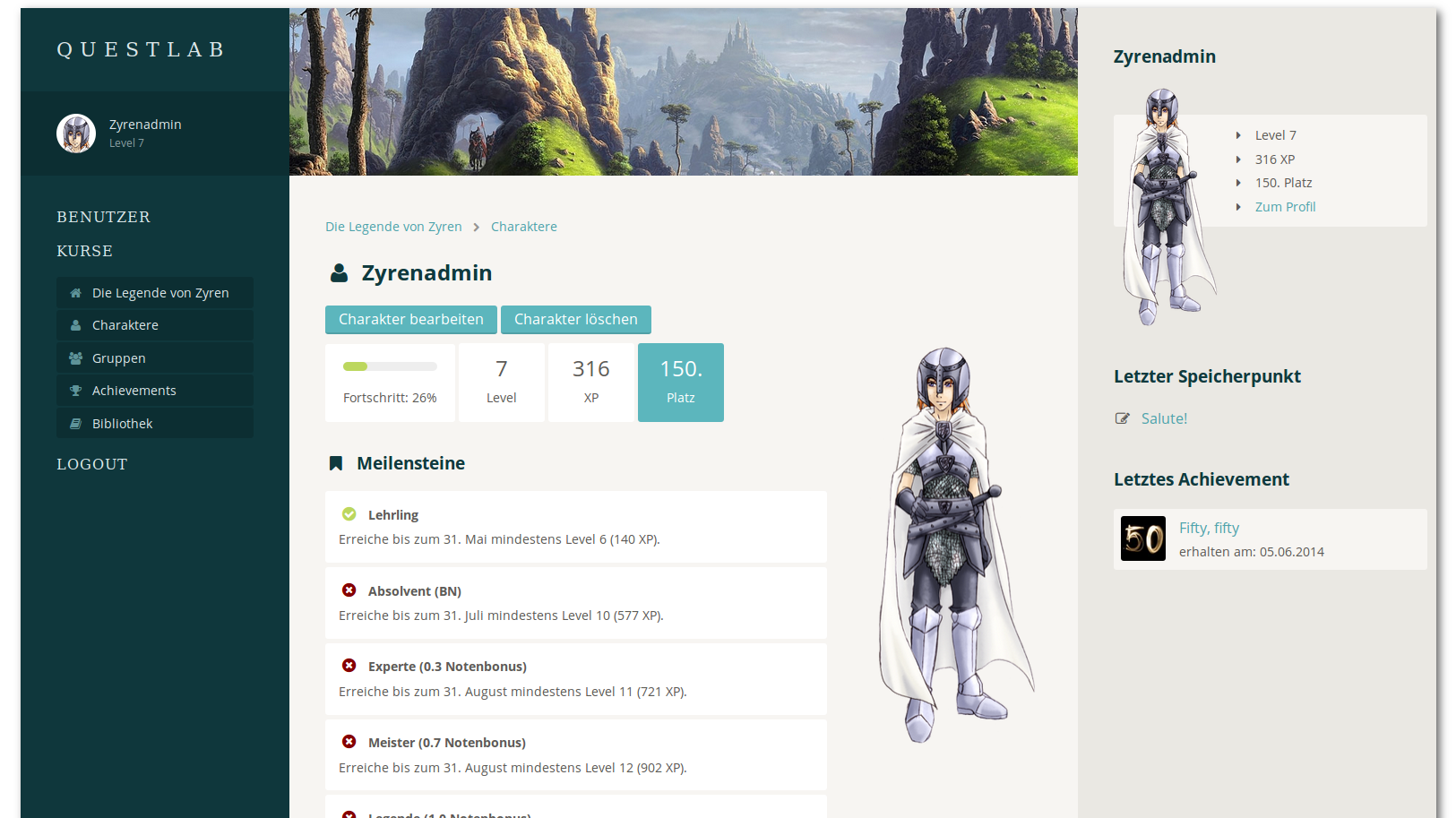
The Legend of Z transforms the contents of a class into an epic quest where students travel the land of Zyren completing quests. Each educational topic in the class corresponds to a narrative quest within the logic of the game. To fight monsters or solve puzzles, the students have to complete quizzes and solve puzzles tied to class content (Knautz, 2013). The creators of “Legend of Z” are Kathrin Knautz (project management), Oliver Hanraths (implementation), and Daniel Miskovic (user interface). They’ve made the web interface they designed to support “legend of Z”, Questlab, available to other teachers who want to adapt it to their own course content (coderkun, 2016). Questlab tries to solve the big issue of adding narrative to course content, which is the work needed to develop an interactive narrative. Kathrin Knautz and her colleagues have developed a whole storyboard of intersecting quests that lead into each other and allow students to make meaningful narrative choices and take on additional challenges (Knautz, 2013). Questlab would theoretically would let any teacher drop their own course content into that existing framework.
Why bother with narrative when other gamification elements are so much easier to implement?
Narrative is a far trickier game element to implement than points, badges, and leaderboards, all of which basically already exist in education. Actual game designer Margaret Robertson makes a compelling argument about why most gamification isn’t gamification at all, but pointsification. Pointsification is essentially the various different ways of measuring and rewarding progress that make up so much of gamification. Pointsification isn’t bad; it’s a great way to show progress to your users and generate quick reward feedback. What pointsification fails at is encouraging the deeper level of engagement that a good game does (Robertson, 2010). Narrative is a great way of raising the levels of interest in a task, leading to deeper levels of engagement that aren’t going to fall off once the novelty of that badge or award wears off. It also adds to the level of meaning to choices made by your players/students/customers.
Citations
Knautz, Kathrin & Soubusta, Simone & Orszullok, Lisa. (2013). Game-based Learning for Digital Natives: Knowledge is Just a Click Away. 10.2991/icaicte.2013.15.
Robertson, M. (2010, November 10). Can’t play, won’t play. Kotaku. https://kotaku.com/cant-play-wont-play-5686393
Coderkun. (2016, November 1). Home. GitHub. https://github.com/coderkun/questlab/wiki
 Making With Ayala
Leave a comment